
Safe Streets & Roads for All (SS4A) Planning Structure
City of Shawnee, Oklahoma
The City of Shawnee’s Safe Streets and Roads for All (SS4A) Action Plan was developed through an established, multidisciplinary planning structure anchored by the Pottawatomie County Built Environment Committee. This committee functions as the primary advisory and community engagement venue for built environment initiatives in Shawnee, including those related to transportation safety, walkability, and community connectivity.
Established in 2017, the Built Environment Committee was created to support long-term improvements to Shawnee’s physical environment with a focus on health, safety, and quality of life. Since its inception, the Built Environment Committee has served as a consistent and active forum for cross-sector collaboration, bringing together stakeholders to guide planning efforts, inform infrastructure priorities, and support implementation of community-driven projects.
Committee Role in Plan Development
The Built Environment was key to developing the SS4A Action Plan, as it both gathered direct feedback from its members and utilized its word-of-mouth network to collect survey responses. Through its routine meetings, the committee facilitated discussion around transportation challenges, safety concerns, and opportunities for infrastructure improvements across Shawnee.
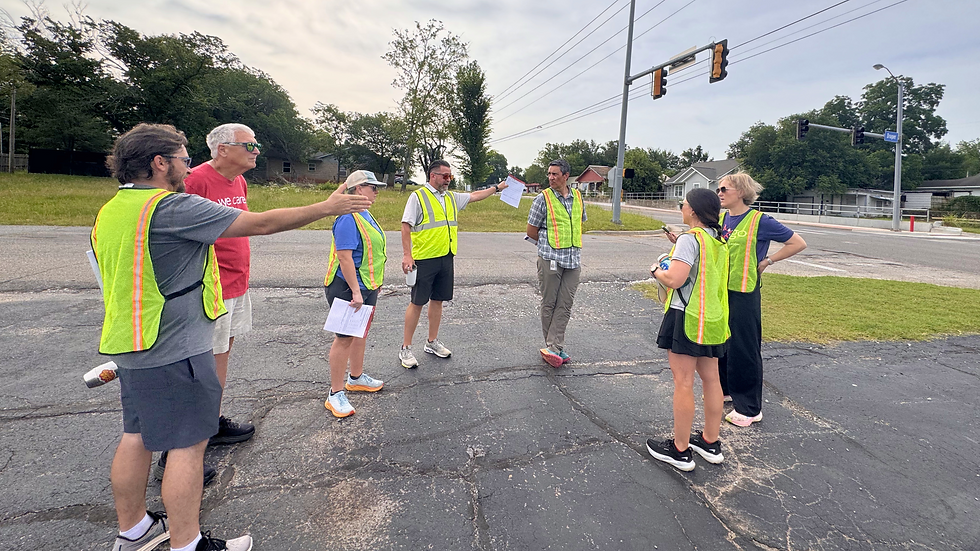
A core function of the Built Environment Committee is community engagement. Through monthly meetings hosted at rotating community locations (e.g., Absentee Shawnee Housing Authority, First United Bank), committee members and guests are invited to share feedback, visions, issues they’ve observed in the community. These regular meetings serve as a consistent medium for monitoring community needs as defined by the people directly affected. The Built Environment Committee was instrumental in the identification of key streets, areas of the city where safety issues most prominent.

In addition to engagement, the Built Environment Committee contributes to awareness-building by helping communicate the importance of built environment improvements, including those that support active transportation and roadway safety. Through these efforts, the committee frames transportation safety not only as an infrastructure issue, but as a broader public health and safety priority.
The committee also plays an advocacy and policy advisory role, supporting planning and design practices that improve walkability, bike-ability, and overall safety. These functions ensured that the SS4A Action Plan aligns with broader community goals related to safety, accessibility, and economic vitality.
Committee Role in Implementation and Monitoring
Beyond plan development, the Built Environment Committee is structured to support ongoing implementation and monitoring of built environment initiatives across Pottawatomie County. The committee meets monthly and may convene additional meetings or subcommittees to focus on specific projects or priority areas. This regular meeting structure provides a consistent mechanism for tracking progress, identifying challenges, and maintaining momentum on implementation efforts.
The Built Environment Committee’s role in implementation includes:
● Providing feedback on project design and phasing
● Supporting coordination between stakeholders and sectors
● Elevating community concerns and real-time feedback
● Advocating for continued investment in safety and infrastructure improvements
The committee’s policy recommendation function also allows it to contribute to long-term monitoring by advising on strategies that improve safety outcomes and align with evolving community needs.
This structure ensures that the SS4A Action Plan is not a one-time planning effort, but part of an ongoing, community-informed process supported by an established governance and engagement body.
Membership and Representation
The Built Environment Committee is intentionally composed of a diverse group of members representing sectors critical to transportation safety and community development. Membership includes individuals and representatives from business, public health, urban planning, housing, parks and recreation, tribal entities, nonprofit organizations, and community advocates.
Current membership reflects this cross-sector approach and includes representatives from local financial institutions and businesses, tribal housing authorities, education institutions, community residents, nonprofit professionals, and real estate professionals.
The committee is open for any community resident to join or attend as a guest. Beyond allowing open participation, Built Environment Committee members are recruited based on their expertise, experience, and commitment to improving Shawnee’s built environment. This structure ensures that planning efforts incorporate a wide range of perspectives, including those related to economic development, housing, public health, and community safety.
Leadership is provided by co-chairs who are responsible for setting agendas, facilitating meetings, and coordinating communication between the committee and broader community initiatives.
Conclusion
The Built Environment Committee serves as a well-established, active, and multidisciplinary planning structure that fulfills the role of a committee, task force, and implementation group for the SS4A Action Plan. Through its consistent meeting structure, diverse membership, and clearly defined roles in engagement, advocacy, and policy development, the Built Environment Committee provides both the foundation for plan development and the framework for ongoing implementation and monitoring.
This existing structure ensures that the Action Plan is grounded in community input, supported by cross-sector collaboration, and positioned for long-term success in improving transportation safety and connectivity in Shawnee.


